Skip to content

Illustrative model · Underwriting

The same park. Three cap rates. Three very different prices.

A quoted cap rate only becomes useful after the income behind it is defined. Start with one income stream, hold everything else constant, and make the sensitivity visible.

Change the assumptions

Make the tradeoff visible.

Illustration · not a valuation
Model output in dollars
6.0% scenario$2,500,000
7.0% scenario$2,142,857
8.0% scenario$1,875,000

Hypothetical inputs only. No market average, appraisal, financing approval or achieved return is implied. See the article for assumptions and exclusions.

01

Start with the denominator

This model assumes $150,000 of annual net operating income. NOI means recurring property income less recurring operating expenses in this example. Debt service, income taxes and capital-event distributions are not included. A reserve for capital works should be disclosed separately rather than silently moved into or out of NOI.

At illustrative capitalization rates of 6%, 7% and 8%, the same $150,000 supports indicated values of $2,500,000, $2,142,857 and $1,875,000. These are calculations, not evidence of what a buyer will pay.

02

Build a bridge from reported to underwritten NOI

For a real review, reconcile billed rent to receipts, isolate vacancy and collections, separate home-rental income from lot income, and identify one-off items. Explain any expense changes using documents or quotes. Each adjustment should have an owner, source and reason.

A rent gap is not automatically new NOI. Timing, collections, recurring costs, capital requirements and applicable rules all affect what reaches the bottom line.

  • Record the starting NOI and measurement period.
  • List each adjustment with a source; do not net away uncertainty.
  • Keep current operations and future operating scenarios in separate columns.
03

Read the range without overclaiming

A one-percentage-point change does not cause a fixed percentage change in value. With constant NOI, moving from 7% to 8% reduces indicated value by 12.5%; moving from 6% to 7% reduces it by approximately 14.3%. The starting rate matters.

Use verified comparable transactions, financing constraints and property-level risks to decide which scenario deserves attention. Do not present an asking-price cap rate as a closed-sale comparable.
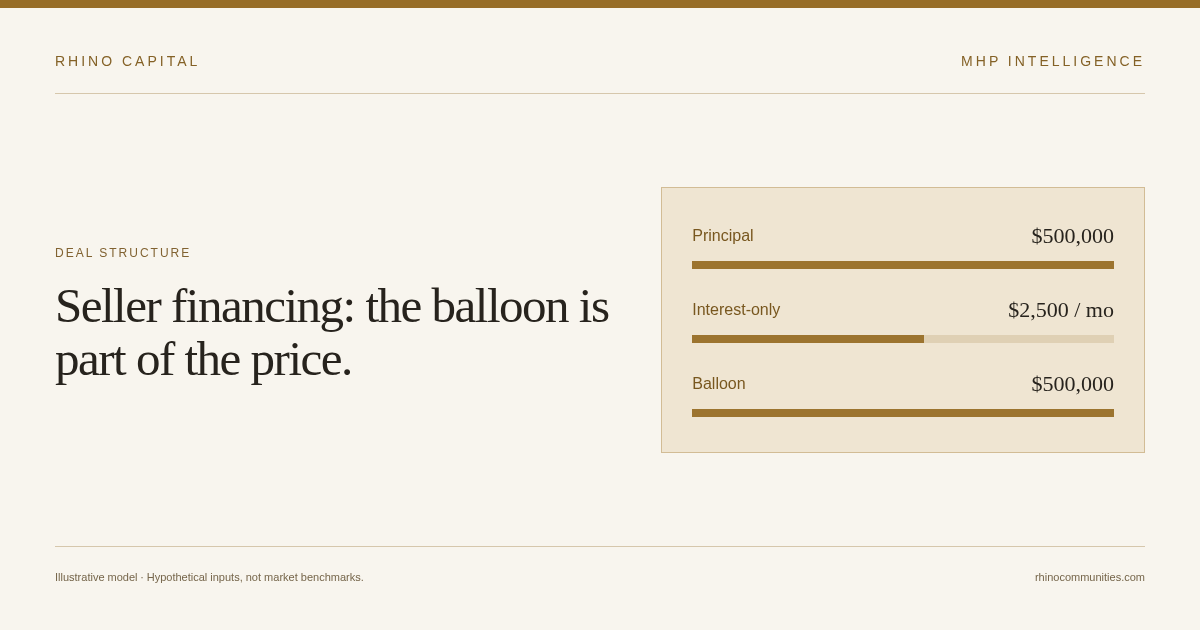
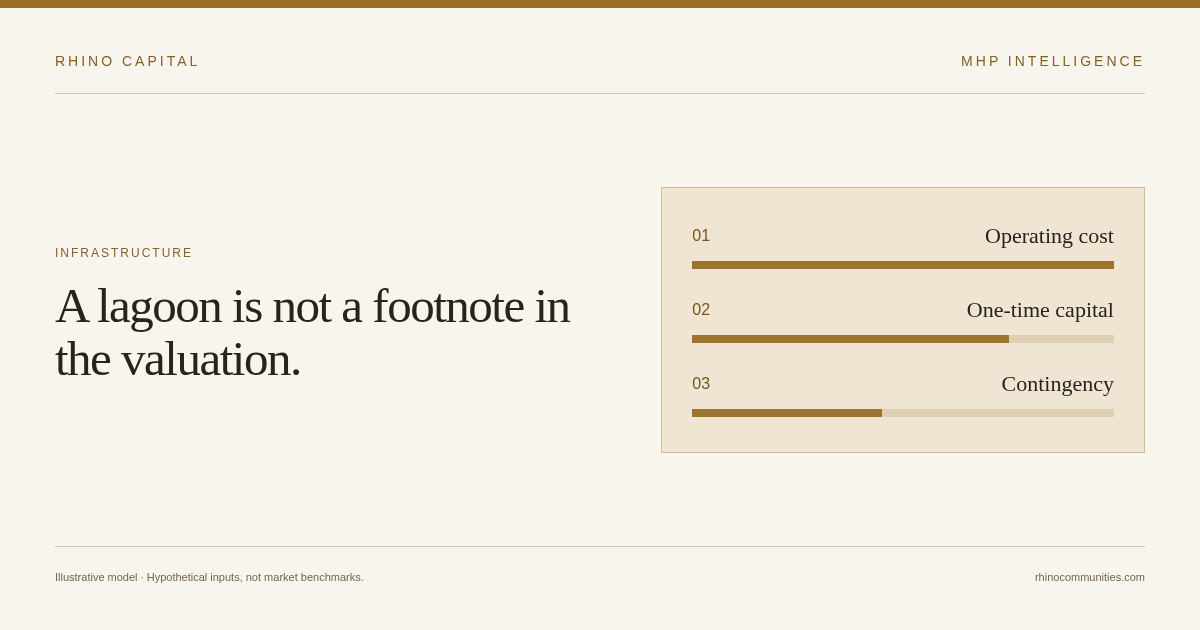
The model in 30 seconds.

Read the full visual explainer transcript

Start with an illustrative annual NOI of $150,000. Divide by a 6% scenario cap rate to obtain $2.5 million. At 7%, the same income gives about $2.143 million. At 8%, it gives $1.875 million. Nothing changed except the assumption. These figures are not comparable sales or an appraisal. Verify the income, support the rate, and separately budget capital work.

Evidence & limitations

Read the source. Question the assumption.

Educational material, not legal, tax, engineering, lending or investment advice. Regulatory requirements are transaction-specific and may change. Anonymized case notes describe process, not results. Models use hypothetical inputs.

Source basis: Original explanatory calculations. Formulas and assumptions are disclosed in the model and downloadable CSV.

Editorial contact: Jason Ramshaw. New articles are issued by Rhino Capital Editorial; personal review by Jason is not implied.

Report a correction or request a source clarification

Bring the actual property.
Start with the actual question.

Your privacy choices

Optional analytics help us improve this site. The inquiry form works without analytics. Privacy details

base44
Edit with Base44
